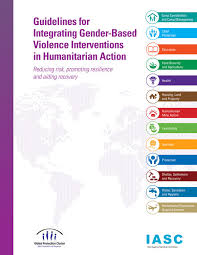
The IASC Guidelines on Gender-based Violence Interventions in Humanitarian Settings (2005) describe GBV as “an umbrella term for any harmful act that is perpetrated against a person’s will, and that is based on socially ascribed (gender) differences between males and females” (p. 7). While the IASC definition reinforces the view that women and girls are the primary victims of GBV because of their subordinate status vis a vis men and boys worldwide, it reflects a broader conceptualization of the term insofar as it suggests that men and boys may be victims of violence that is based on socially determined roles, expectations and behaviours linked to ideas about masculinity.
Following from the IASC definition, the majority of work of the GBV AoR and its partners prioritises the problem of violence against women and girls. However, a focus on women and girls does not suggest that efforts should exclude men and boys. Rather, prioritising women and girls underscores the fact that the GBV AoR and its partners are committed to bringing greater attention to and ensuring greater accountability for the global problem of violence against women and girls in humanitarian contexts.
In the early stages of humanitarian emergencies, sexual violence and intimate partner violence are often the most common forms of GBV. In some contexts, sexual violence may be used as a tool of war. Other forms of GBV that can emerge in humanitarian settings include trafficking, forced and/or coerced prostitution, and harmful practices such as forced or child marriage, honor killing, widow inheritance and female genital mutilation.